
[ TECHNOLOGY / PAYMENTS ]
Interledger and the future of global payments
Payments still don't move between networks the way information does. What open payment protocols could change for businesses — and what they won't.
What happens when value can move between networks the way information moves between computers?
A photo can cross the world before you finish this sentence. Money still has to negotiate banks, currencies, payment providers, fees and—on a bad day—a heroic amount of waiting.
That mismatch is the problem Interledger is built to rethink.
The goal is not one giant global payment system. It is many systems that know how to talk to one another.
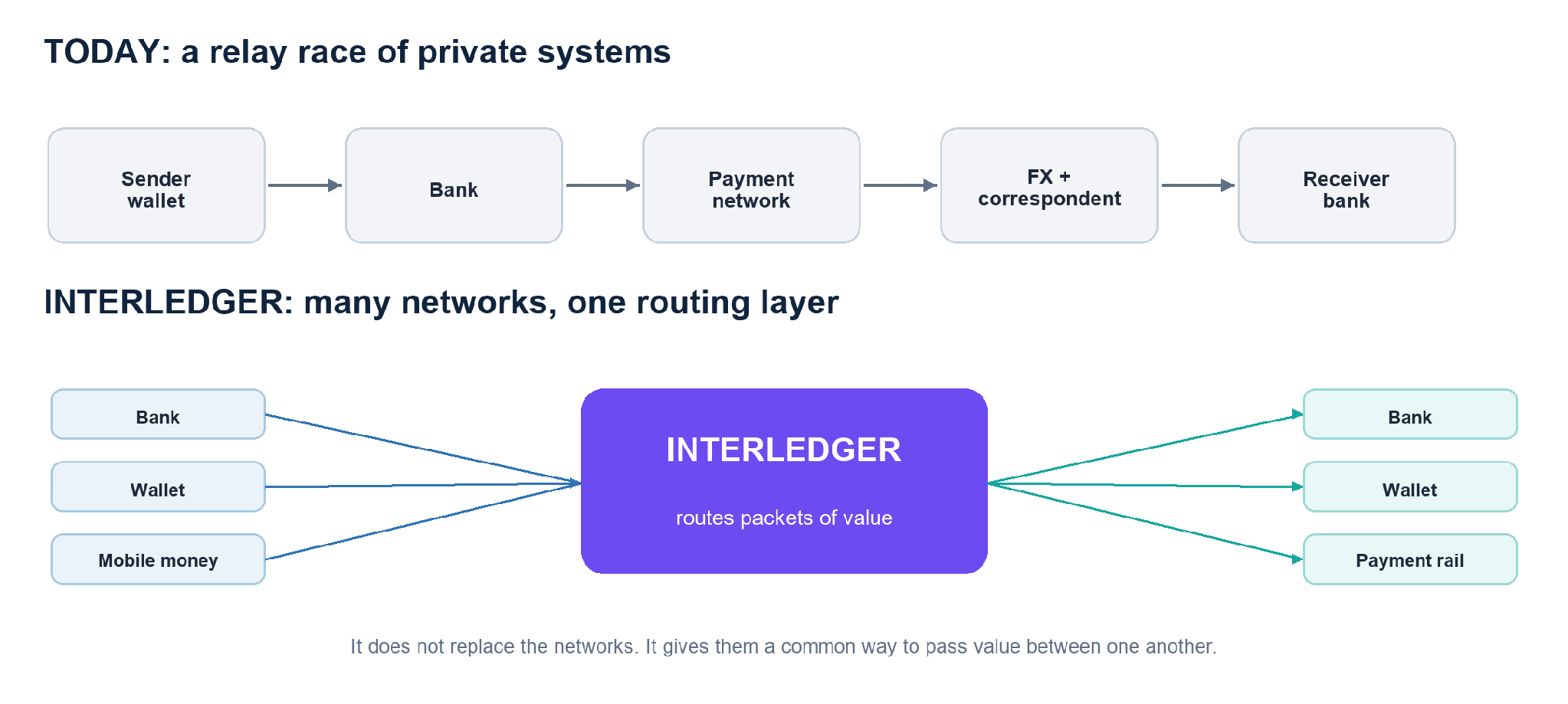
Visual 1. Traditional cross-border payments add network-specific hand-offs; Interledger introduces a shared routing layer. Source: Interledger Protocol overview
First, the uncomfortable number
The World Bank’s latest published quarterly report puts the global average cost of sending a $200 remittance at 6.36%. Banks averaged 14.99%—while the UN target is below 3% by 2030.
Digital options are cheaper on average, but “cheaper” is not the same as “frictionless.” Cross-border payments still trail domestic payments on cost, speed, access and transparency; the BIS identifies limited interoperability as a central constraint.
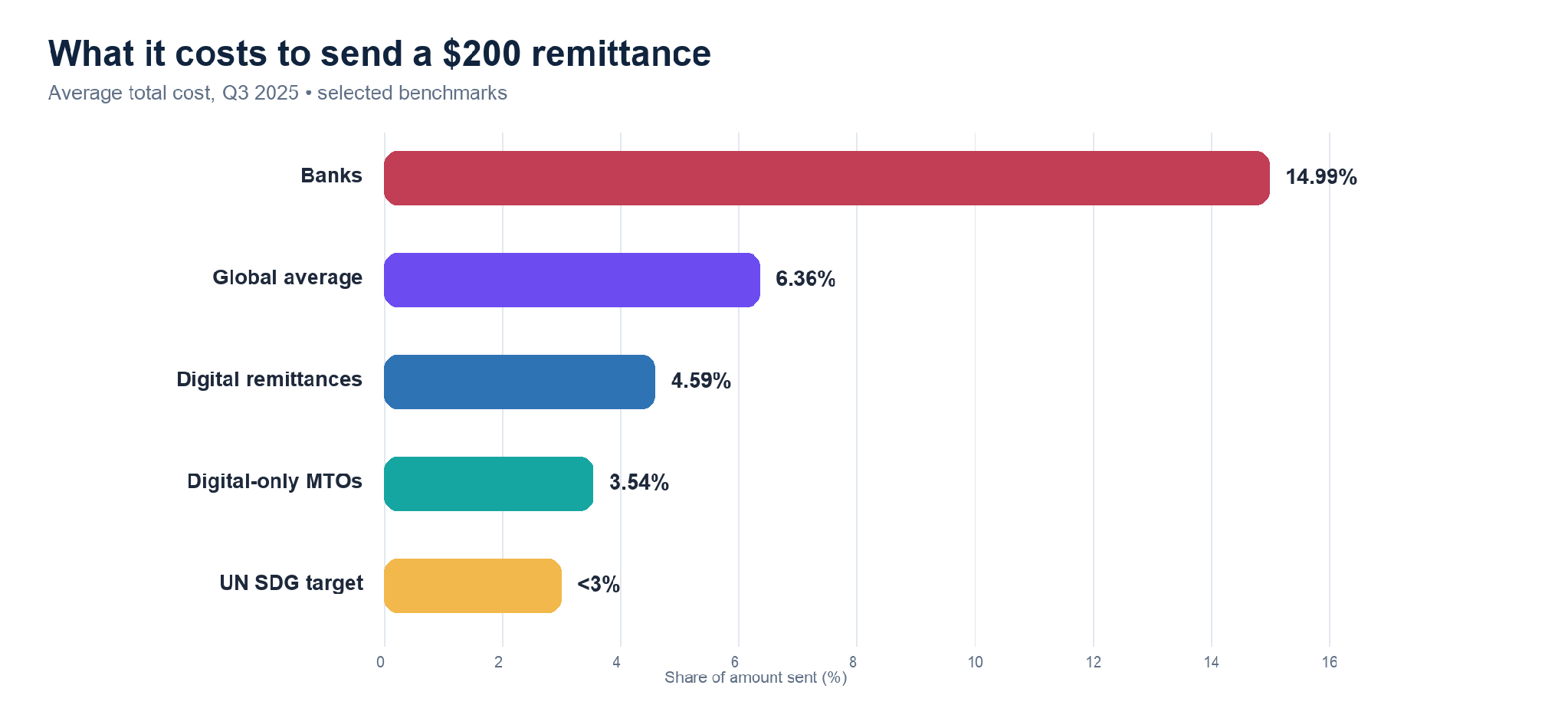
Visual 2. Selected Q3 2025 remittance-cost benchmarks. “MTO” means money-transfer operator. Source: World Bank, Remittance Prices Worldwide Q3 2025
Target reference: UN Sustainable Development Goal 10.c
So what does Interledger actually do?
Interledger Protocol (ILP) is an open protocol suite for sending packets of value across independent payment networks. A sender sends packets; connectors forward them—potentially applying currency conversion—and a receiver fulfils or rejects them.
A larger payment can be split into many small packets. That makes the protocol a natural foundation for low-value and streaming-payment ideas. ILP is not a new bank, wallet or currency. It is infrastructure designed to connect them.
Then Open Payments makes it usable
Interledger answers how value can move. Open Payments gives applications a standard way to set up payments between enabled accounts—using resources for incoming payments, quotes and outgoing payments, plus delegated authorization.
Its wallet addresses are public HTTPS identifiers, such as https://wallet.example/reda. Simple on the surface; provider infrastructure underneath.
From payment buttons to payment flows
Most online payments are events: click, pay, done. Packetized value makes a different design space imaginable—money that moves in tiny amounts as content, compute or services are consumed.
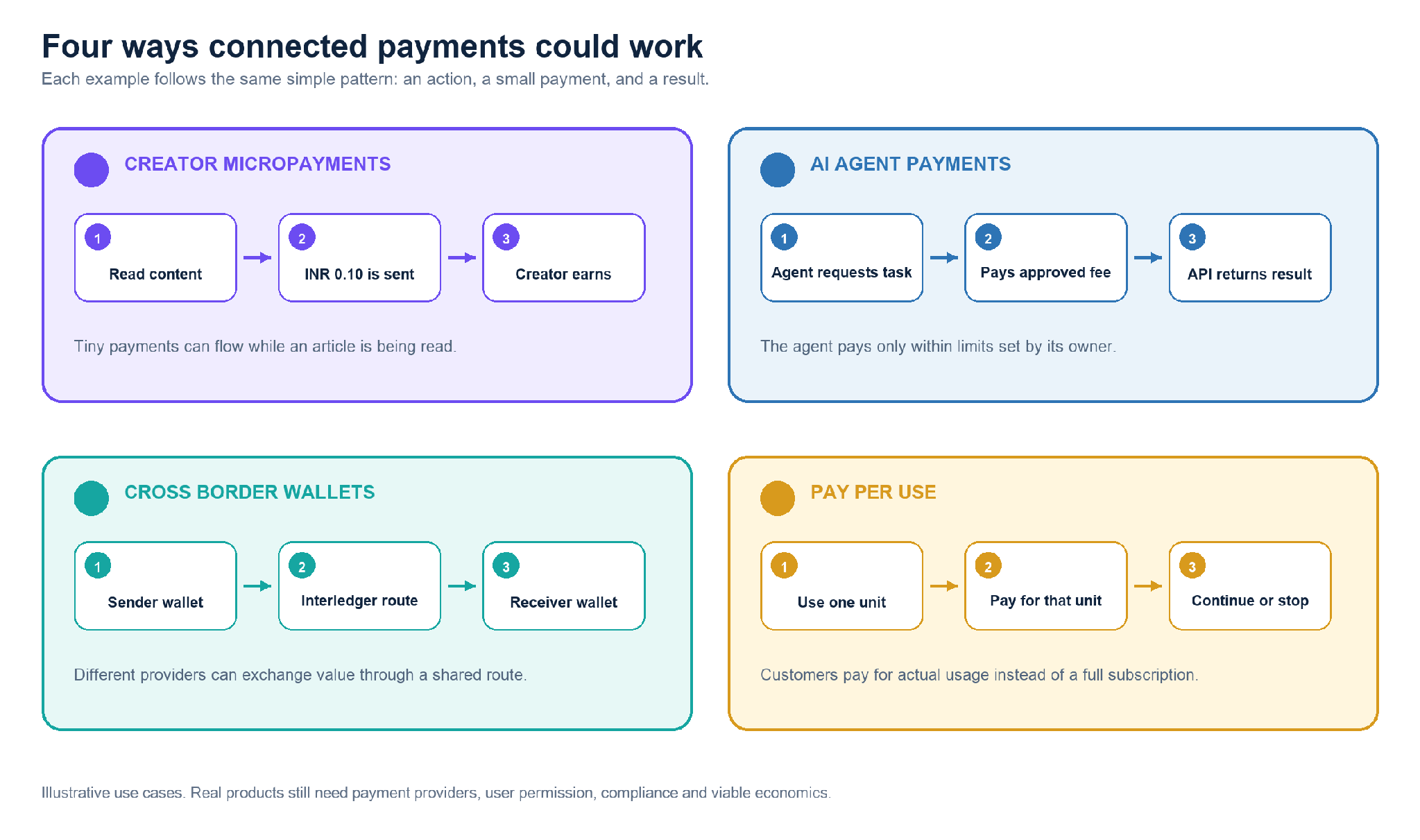
Visual 3. Four builder-facing patterns enabled by small, programmable transfers. Source: Interledger architecture
A reader could tip a creator a few paise while reading. A wallet could pay another provider across currencies. A product could charge for one API call instead of one monthly subscription. An AI agent could—once explicitly authorized—purchase a query or burst of compute without opening a checkout page.
The important word is could. Interledger supplies routing primitives, not instant product-market fit. Someone still has to build the provider relationships, permissions, user experience and economics.
Connected money needs connected evidence
Interoperability can spread a single transaction across more systems. When something goes wrong, investigators may need to correlate transaction IDs, timestamps, authorization events, quotes and provider logs to reconstruct the route.
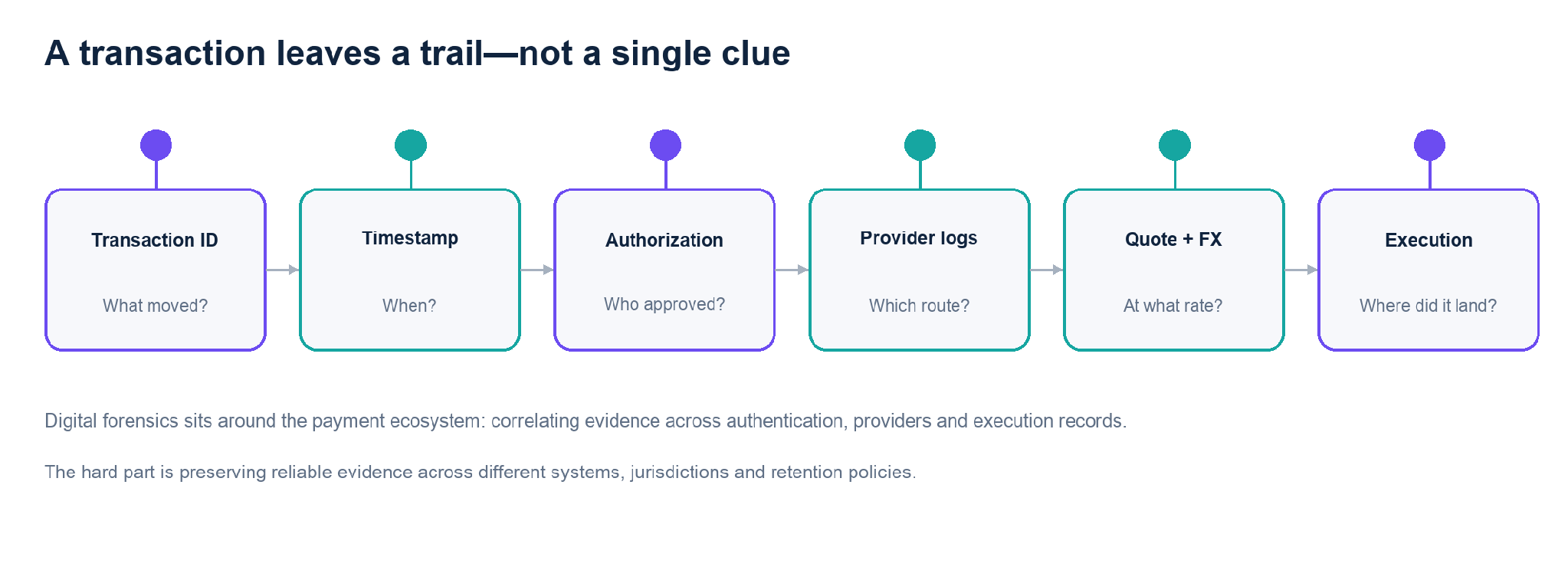
Visual 4. A conceptual digital-forensics trail around an interoperable payment. Digital forensics is a complementary investigation layer—not a component of ILP itself.
The research question is compelling: can investigators reconstruct the journey of money with the same discipline cybersecurity teams use to reconstruct an attack? Doing that well requires trustworthy logs, clock synchronization, evidence retention, access controls and cooperation across providers and jurisdictions.
A protocol cannot delete reality
Interledger addresses one huge piece of the puzzle: interoperability. It does not make regulation, KYC/AML, sanctions checks, liquidity, foreign-exchange risk, fraud, disputes, taxation or consumer protection disappear. The BIS is blunt on this point: technical innovation alone cannot overcome every institutional difference in cross-border payments.
Interledger is best understood as a common route—not a magic shortcut around finance.
Traditional vs. interoperable
Lens | Traditional model | Interledger-style model |
|---|---|---|
Architecture | Network-specific links | Shared protocol across networks |
Integration | Many bespoke connections | Common routing + standard APIs |
Value movement | Often one large transaction | Can use many low-value packets |
Currencies | Corridor/provider dependent | Protocol is currency agnostic |
Existing systems | Wrapped or separately integrated | Designed to connect them |
Reality check | Mature rails and rules | Adoption, liquidity and compliance still required |
Visual 5. An architecture comparison—not a claim of guaranteed speed, cost or adoption.
The builder question
For builders, the exciting question is not “Will Interledger fix global finance?” It is smaller, sharper and more useful:
What can we build when software can route value as naturally as it routes information?
A cross-border student wallet. A pay-per-second learning platform. A creator stream. An AI-agent budget with explicit limits. A fraud-investigation dashboard that follows a payment across providers.
This is where builders can contribute: by prototyping the interfaces, safeguards and business models that turn an open protocol into something people can actually use.
Different networks. Different currencies. One connected future.
Sources & verification notes
1. World Bank: Remittance Prices Worldwide — Q3 2025 report
2. United Nations: Sustainable Development Goal 10.c
3. Interledger Foundation: Interledger Protocol overview
4. Interledger Foundation: Interledger Protocol V4 specification
5. Open Payments: Open Payments concepts
6. Bank for International Settlements: Cross-border payment technologies: innovations and challenges (11 March 2026)
Editorial note: future-facing use cases are framed as possibilities, not deployment or performance claims. The digital-forensics diagram is a research concept around the ecosystem, not an ILP feature.